From debris to resources: circular reconstruction of Ukraine discussed at Padova Climate Week

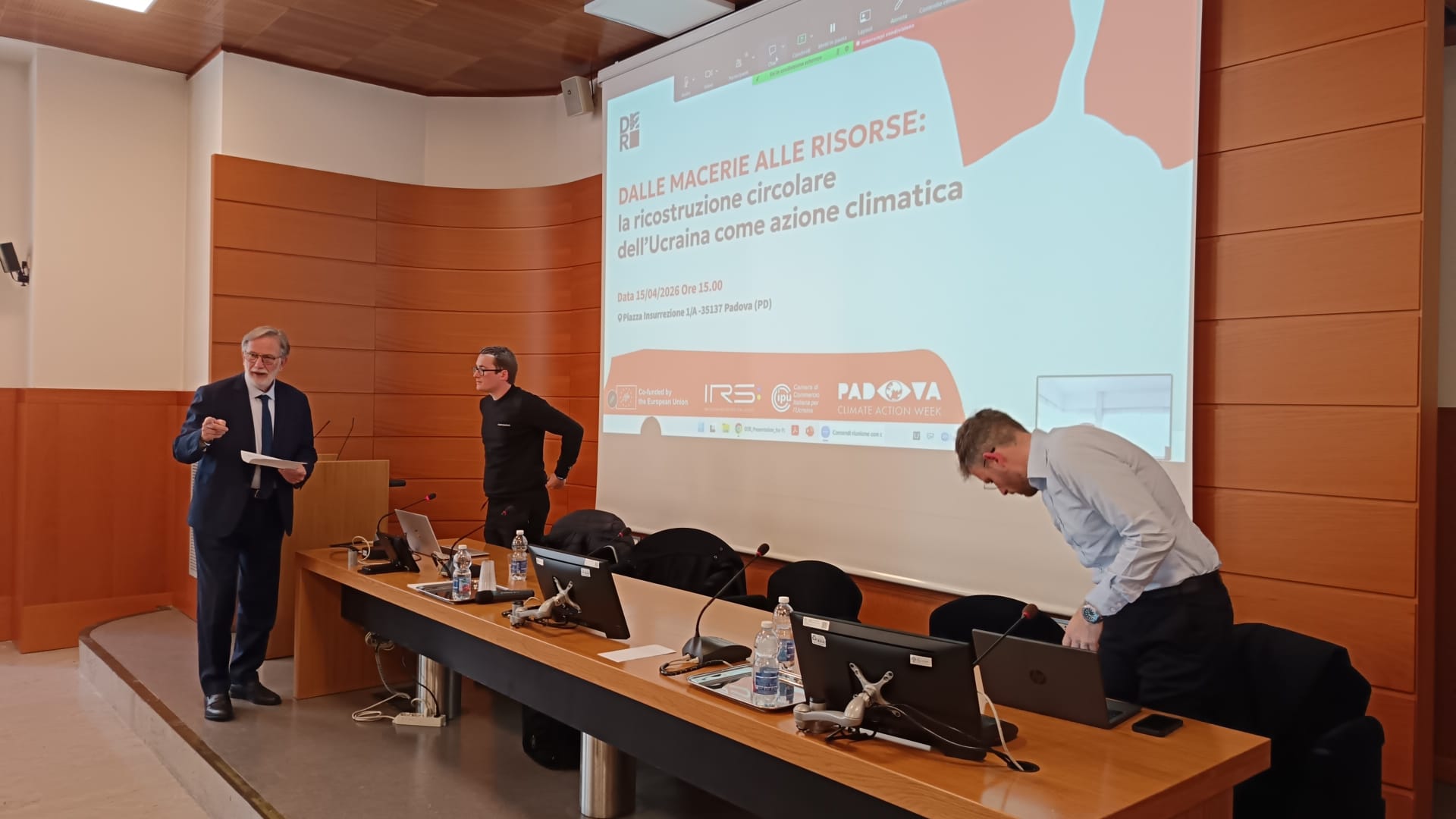
On 15 April, an international roundtable “From Debris to Resources” took place within the Climate Action Week in Padova, Italy. The discussion was organised by the Debris2Resource (D2R) consortium, bringing together experts and practitioners working across reconstruction, circular economy, and climate policy.
The conversation focused on how debris from destruction can be addressed not only as an immediate response to damage, but as part of a broader system that supports recovery, environmental protection, and alignment with EU standards.
The discussion moved beyond viewing debris as a purely technical issue. Participants highlighted that demolition debris sits at the intersection of legal frameworks, environmental risks, and governance capacity.
In this context, circular reconstruction becomes a way to connect these dimensions, linking debris management with climate action, industrial recovery, and long-term resource efficiency. The roundtable also presented the approach of the D2R project, including its objectives, ongoing activities, and early lessons from pilot implementation.
As noted by Matteo Solivo (Microfinanza), scalable approaches are essential to move from isolated solutions to systemic change:
“We need to design and develop scalable models, engaging public and private partners to drive innovation.”
A key part of the discussion was the Ukrainian perspective, presented by Sofiya Shutiak, legal analyst at the City Institute Lviv.
She framed the challenge through the nature of the material itself:
“We are not managing construction and demolition waste as defined in EU directives. We are managing destruction waste, chaotic, contaminated, and emotionally charged.”
This distinction defines the scale and complexity of the problem. Unlike planned demolition, war debris appears suddenly, combining multiple material streams, often mixed with hazardous substances, and requiring entirely different approaches to classification, tracking, and processing.
In practice, several gaps become visible.
Classification and traceability remain limited, with municipalities lacking simple tools for on-site identification of materials. At the same time, there is a constant tension between the urgency to clear sites and the need to follow environmental and legal procedures.
Responsibility is another unresolved issue, as existing frameworks are not fully adapted to wartime conditions. Infrastructure gaps further complicate the situation, with limited capacity for sorting, processing, and recycling.
Despite these constraints, the discussion highlighted that circular approaches are already being tested in practice, from reuse of materials in local reconstruction to the development of new value chains around debris processing.
At a systemic level, three directions emerged as key: strengthening legal frameworks, building local capacity, and expanding international cooperation.
The approach presented looks beyond direct costs and includes broader impacts such as reduced emissions, avoided landfill use, and local economic development. This reinforces the idea that debris can become a resource within a well-designed system.
Speakers included Renato Walter Togni (CCIPU), Vladislav Malashevskyy (IRS), Domenico Vito (IRS), Matteo Solivo (Microfinanza), and Sofiya Shutiak (Lviv City Institute).
The discussion concluded with a shared understanding that managing war debris is not only about clearing space, but about shaping the future of reconstruction.
Circular economy principles offer a pathway to move from fragmented responses to more systemic solutions, connecting local realities in Ukraine with international expertise and long-term sustainability goals.